An Evaluation of Lines and Text Quality for Paper-based Packaging Using UV Wide-format Inkjet Printer
Dr. Yu-Ju Wu
Appalachian State University
Published 2024
DownloadAbstract
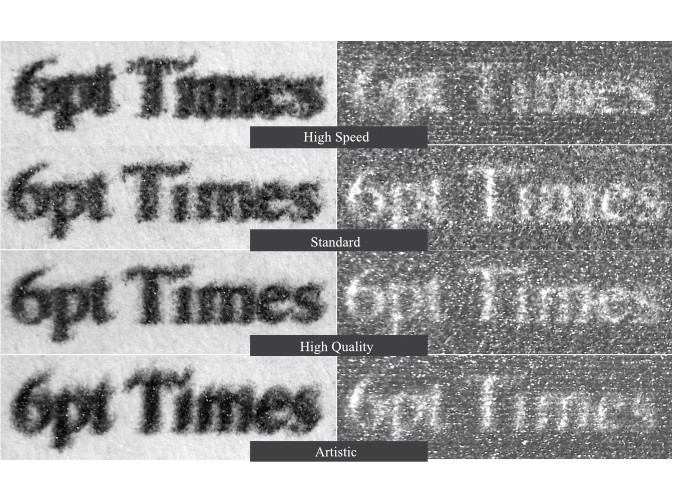
Printed packaging is used to provide the consumer with details about the contents and use of a particular product. Some of this information is legally required, such as weight, vendor details, information about composition, description of contents and presence of allergens and nutritional details, etc. Customers are utilizing digital printing technology to meet compliance with changing global regulations quickly and effectively, by taking advantage of the high-resolution barcodes, QR codes, and data matrices on offer. The ability of a printing system to reproduce a sharp image with clear details is of crucial importance for high-quality reproduction. The main purpose of this experimental study is to evaluate lines and text quality for paperboard and corrugated board using UV Wide-format Inkjet Printer. A Roland VersaUV LEJ-640 UV LED printer with Eco UV-curable inks will be employed in this study. The test target is monochrome containing text and line resolution target. The text was printed in Times New Roman in 2, 4, 6, 8, 10, and 12 pt. The line dimensions are specified in points (72 points per inch) in a range from 0.01 points to 1 point. The positive version of the target used dark colors for the lines and text elements on a light background, and the negative versions of the target used light colors for the lines and text elements on a dark background. The test target also includes elements such as barcode, QR code, intelligent mail barcode, and nutrition facts as visual assessment. The results of this research have shown that printed packaging with information such as barcode, QR code, intelligent mail barcode, and nutrition facts are readable and/or scannable. Positive font size can be as small as 4 pt on the corrugated board and 2 pt on the paperboard. Positive line elements can be as small as 0.01 point while negative line elements can be as small as 0.40 point. Excessive edge noise of fine elements affects the clarity and visibility of the elements as well as the shape fidelity and legibility of the text.