Comparison of Color Profiles Between Two Digital Presses
Celeste Calkins, Ph.D. 1 and Renmei Xu, Ph.D. 2
1 Illinois State University; 2 Ball State University
Published 2024
DownloadAbstract
It has been over 30 years since the first digital presses were released. Since its start, digital printing has revolutionized the printing industry, offering a host of benefits that cater to a wide range of applications and industries. With continual development and improvement, we now have high quality, cost-effective short run capabilities with quick turnaround times. Further, digital printing provides customers opportunities to incorporate variable data for target marketing and print on demand capabilities. With minimal setup costs, no minimum quantity, and ondemandpublishing, digital printing has transformed the way businesses approach their printing needs. Color management on digital presses is a valuable feature that offers numerous benefits that enhance the efficiency, accuracy, and consistency of color reproduction in the printing process. It plays a critical role in ensuring that printed materials meet color specifications, maintain consistency, and meet the expectations of customers.
In this study, a Konica Minolta AccurioPress C2070 and an HP Indigo 7K were used. In both instances, custom color profiles were generated for eight different paper substrates, three uncoated and five coated. The G7® method was used for calibration and then 1,617 patches (CGATS IT8.7/4) were printed and measured offline.
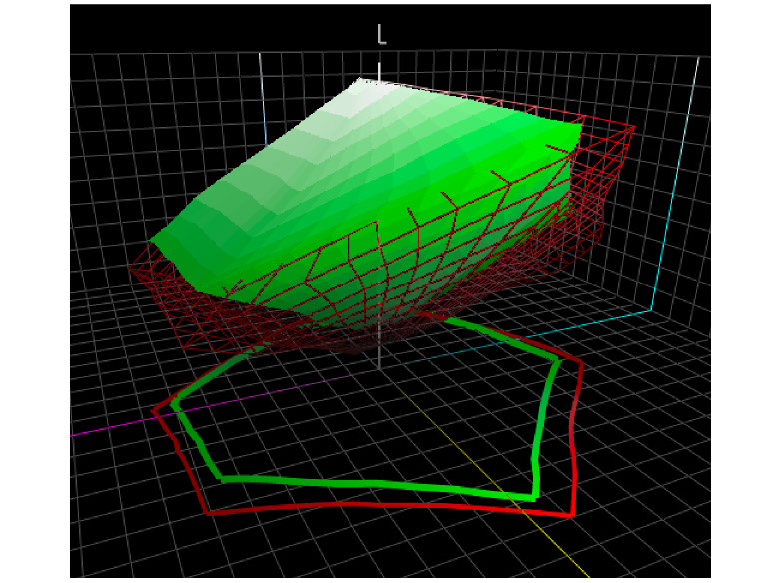
Profiles created were then evaluated and compared in CHROMiX ColorThink Pro. It was found that the differences in gamut volume between the two presses were rather significant, with the Konica Minolta resulting in a larger color range as compared to the HP Indigo. The differences were substantially larger for the uncoated substrates (27.7%-30.5%) as compared to those of the coated (2.9%-11.9%).