Polytetrafluoroethylene (PTFE) vs. PTFE-Free Coatings on Paper Label: Analysis of Label Mechanical and Performance Properties
Chuqi Su
Rochester Institute of Technology; Rhodes Graduate Award Recipient
Published 2024
DownloadAbstract
Post-printed water-based (WB) coatings, commonly known as aqueous coatings, have gained popularity for paper-based label manufacturing because of their environmentally friendly characteristics. Polytetrafluoroethylene (PTFE) is one of the common additives added to the WB coatings to achieve heat resistance and rub resistance properties for the final product. PTFE is a synthetic fluoropolymer of tetrafluoroethylene, and is a category of Polyfluorinated Substances (PFAS). As of January 2024, the sale of food packaging containing PFAS is prohibited in the state of Minnesota, with expectations that this regulation will extend to other states because of the proven harm of PFAS to both humans and animals. PTFE-free WB coatings are emerging as an alternative; thus prompting the need to assess their performance. This research investigates whether PTFE-free WB coating can match the performance of PTFE WB coating for food packaging. The discussion focuses on comparing the impact of these coatings on mechanical properties and label performance of paper labels to inform potential future adopters of PFTE-free aqueous coatings for paper-based label application of mechanical properties and label performance factors as compared to aqueous coatings containing PFTE. The result shows that PTFE-free coating could be an acceptable alternative coating. With the exception of water- resistant properties, the tested PTFE-free coating equals or exceeds the PTFE coatings for rub, humidity, grease, heat, and pressure resistance abilities.
Paper serves as a frequently used substrate in the label printing industry. According to the Markets and Markets forecasting, paper and paperboard materials occupy onethird of the global packaging industry share (Trent, 2019; Tyagi et al., 2021). Paper and paperboard offer excellent characteristics for packaging applications, including stable mechanical properties, light weight, effective light barrier properties, ease of conversion and printing, recyclability, and utilization of renewable resources (Rhim & Kim, 2009). Because of papers’ susceptibility to contamination and breakdown when exposed to water, oil, and heat, applying a post-printed aqueous coating is crucial to provide essential protection for paper-based labels (Tyagi et al., 2021). The label industry seeks materials that are less hazardous and more environmentally sustainable than incumbent products while maintaining important performance characteristics, including barrier properties. Stable water-based (WB) coatings can meet these requirements (Bakker et al., 2022).
Sixty to seventy percent of WB coatings are water; the remainder is comprised of solid materials. When the WB coating is applied to the substrate, the water component evaporates, and the solid particles form a water-insoluble film on the substrate. Acrylic resin, wax, surfactant, ammonia, and additives are basic components of the solid material in WB coatings. In addition, Polytetrafluoroethylene (PTFE) is frequently incorporated into WB coatings to enhance the product’s heat and rub resistance. PTFE is a synthetic fluoropolymer derived from tetrafluoroethylene and falls under the fluoropolymer category of Polyfluorinated Substances (PFAS) (Lohmann et al., 2020). PFAS is commonly used in food packaging due to its hydrophobic and lipophobic properties.
One concern with using PFAS is its link to health problems. According to epidemiological studies, exposure to long-chain PFAS-contained products can contribute to kidney and testicular cancer, low birth weight, thyroid disease, decreased sperm quality, pregnancy-induced hypertension, and immunotoxicity in children. Furthermore, toxicological investigations in animals have established connections between exposure to PFAS and changes in mammary gland development, reproductive and developmental toxicity, testicular cancer, obesity, and immune suppression (Schaider et al., 2017). The SF 20 regulation, signed into law in June 2021 and active in January 2024 in Minnesota, prohibits the utilization of perfluoroalkyl and polyfluoroalkyl substances (PFAS) on food packaging labels (Tsang, 2021). Eleven states have implemented measures to gradually eliminate the use of PFAS in food packaging (Safer States, 2024). Because of the concern about the adverse health effects of PFAS, prominent coating manufacturers have developed PTFE-free WB coating as an alternative to reduce PFAS residue on the labels.
The purpose of this research is to evaluate and compare the PTFE-free and PTFE WB coating performance on paper labels. A thorough examination of existing literature yielded no documented studies that compare PTFE and PTFE-free WB coating; the present research will focus on the influence of PTFE-free and PTFE coating on label mechanical properties and label performance. Two paper stocks, denoted Paper A (60#) and Paper B (47#) were used as testing substrates. Papers A and B were printed and coated using a Heidelberg XL 106 Sheetfed Offset Press.Testing included analyzing unprinted Papers A and B, and then again after the papers were printed and coated.
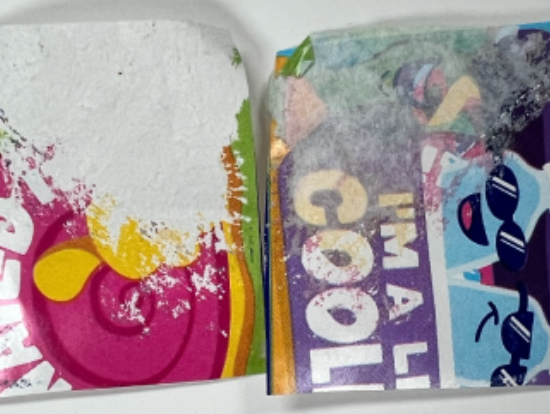
Unprinted papers were subject to paper characteristic tests, including thickness and basis weight measurement, to describe the basic structural properties of the paper. Printed and coated substrates were tested for mechanical properties and label performance. The mechanical properties of the papers were analyzed using tests focused on the label-finishing process, including coefficient of friction, dry and wet rub, and wet blocking. The coefficient of friction test determines the force to separate two sheets of label samples during finishing. Dry and wet rub tests measure the abrasion resistance of label coating. The wet blocking test measures the durability of label coating under high pressure and replicates the humidity present in a typical label finishing environment. To assess label performance, the printed and coated papers were tested for water absorptiveness, heat resistance, and grease resistance. These tests gauge the performance of the label coating under conditions involving high volumes of water and oil, as well as at elevated temperatures.