Printing for and in Space: Novel Applications and Opportunities for Printing Technology on the Frontier
Sean Garnsey, Matthew Trippy, and William Paul Flynn
Enova Concepts, LLC
Published 2026
DownloadAbstract
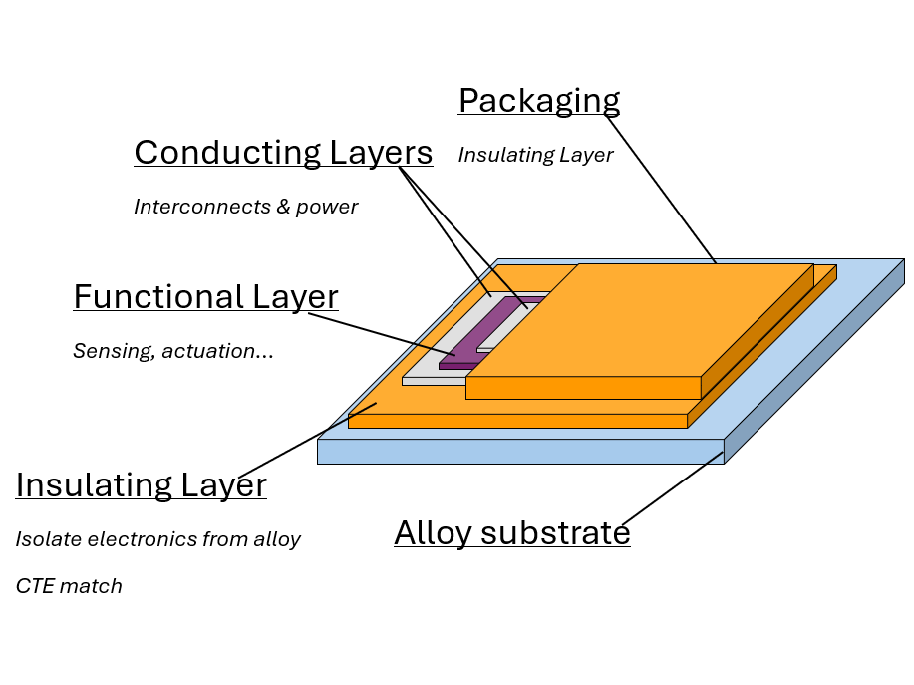
The history of printing has been defined by disruption, adaptation, and the continual evolution of specialized manufacturing systems. Printing is inherently multidisciplinary, uniting mechanical, chemical, and electronic systems to transform a pattern into a product, and the term “printer” has been adopted across science and engineering to describe machines that fabricate patterned materials. This broadening invites the graphic communication industry to extend its expertise into printed electronics. This paper reviews the shared heritage of the printing and electronics industries and reports work undertaken by Enova Concepts, with the NASA Jet Propulsion Laboratory and the University of Texas at San Antonio, to develop COLDFRONT, a printed materials set for electronics able to survive the harsh space environment. Candidate materials were screened with a structured selection framework; a custom-formulated dielectric, a silver nanoparticle conductor, and a barium titanate functional material were chosen and built on aerospace alloy substrates. Temperature-dependent thermomechanical models, correlated to experimental data at R² = 0.94, guided the design toward thermal-expansion compatibility. Specimens fabricated by inkjet and direct ink writing retained full adhesion and electrical function through fifteen thermal-shock cycles between −180 °C and +10 °C, with cross-hatch adhesion at the highest ASTM D3359 rating (5B), and the dielectric remained functional below −180 °C. The work shows the role that printing technology may play in realizing applications that shape the 21st century.