Analyzing Gravure Cylinder Engraving Factors to Reduce White Ink Consumption and Improve Spot Color Quality on clear CPET Films
Kanishka Sahu
Rochester Institute of Technology
Published 2026
DownloadAbstract
Gravure printing on transparent substrates, such as clear CPET films, requires a white ink underlay to achieve vibrant spot color reproduction and opacity. White ink underlays play a critical role in reverse gravure printing on transparent substrates by enhancing color vibrancy, suppressing background interference, and ensuring consistent spot color reproduction. These underlayers act as an optical barrier, enhancing opacity, suppressing background interference, and enabling accurate color rendering in reverse-printed packaging applications (Eller & D’Amico, 2022; Tomerlin et al., 2023). However, white ink is also one of the most resource-intensive inks used in packaging, making its optimization crucial for cost efficiency and sustainability (Desai & Hansen, n.d.). While previous studies have explored ink transfer characteristics and print quality at a broad level (Gencoglu, 2005; Deng et al., 2014), there remains a lack of systematic, quantitative investigations linking specific gravure engraving parameters to white ink consumption and spot color accuracy on transparent films.
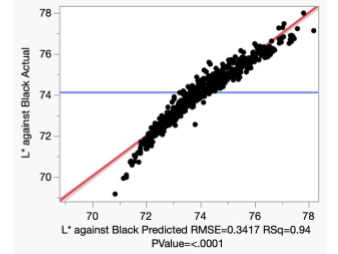
This study investigates the effects of gravure engraving parameters: line screen, screen angle, and stylus angle, on white ink consumption, opacity, lightness (L*), and ΔE00 spot color accuracy when printing on 45-micron clear Crystallized Polyethylene Terephthalate (CPET) film. Both single-hit and two-hit white underlay configurations were evaluated under varying ink viscosities, with print performance metrics collected and analyzed through correlation analysis, ANOVA, and regression modeling. Results revealed a strong positive correlation between engraving cell volume in Billion Cubic Microns (BCM) and both opacity and lightness, validating the critical role of ink volume in achieving optimal visual outcomes.
However, variations in ΔE00 for spot colors were partially explained by BCM, indicating that additional variables influence spot color fidelity.
An optimization study using JMP's Prediction Profiler identified 33 engraving combinations capable of reducing total white ink laydown below the industry-standard engraving combination with cell volume of 20.8 BCM while maintaining acceptable print quality and color fidelity. These findings support the application of data-driven optimization in gravure printing to reduce ink consumption without compromising print quality, while also highlighting areas for future research in color variability and ink-substrate interactions.